

Indra Group consolidates its position as a benchmark in lightweight electronic warfare in Europe and presents a new tethered drone-mounted system at Eurosatory
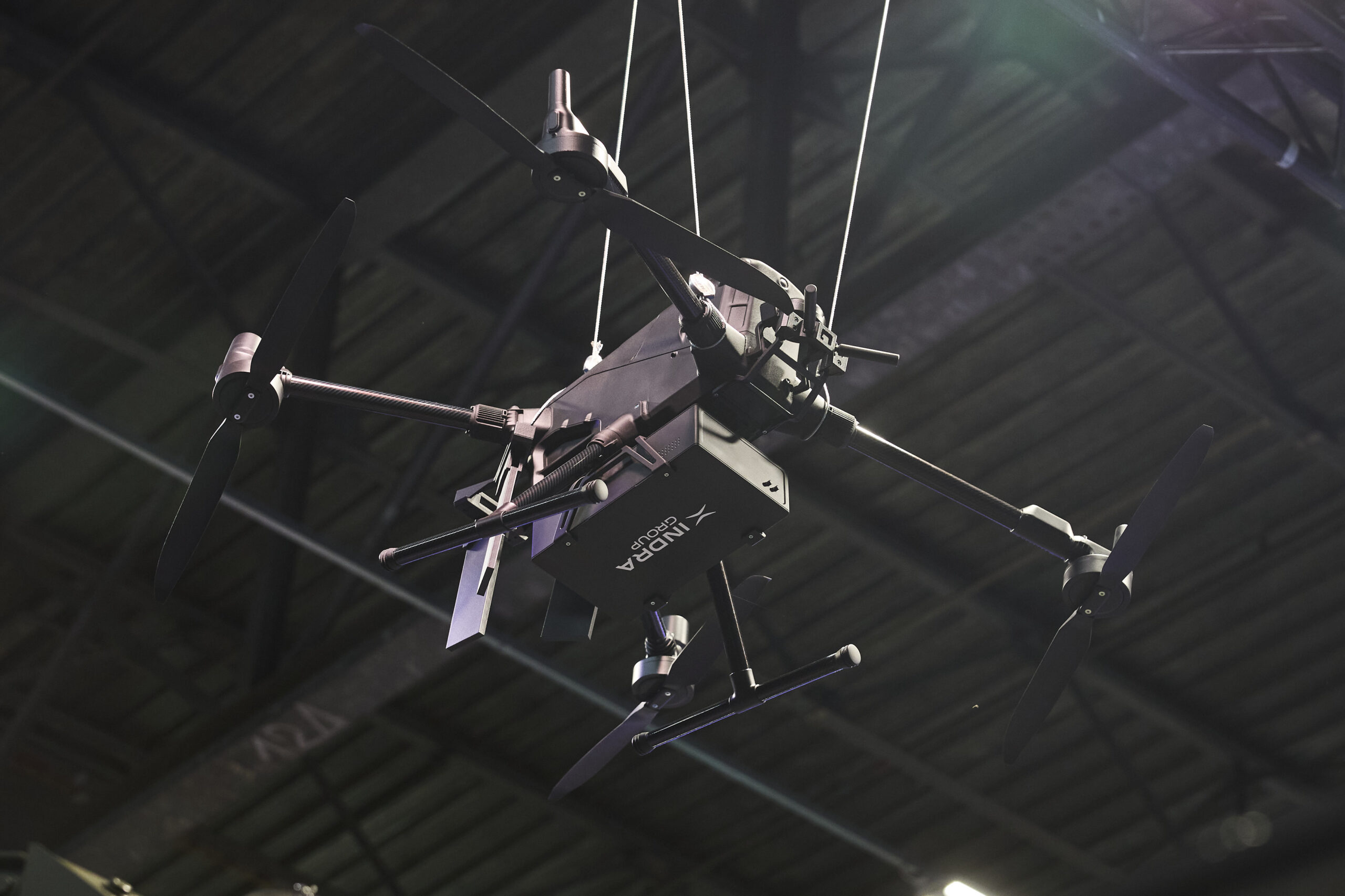
The system consists of a quadcopter connected to a 4x4 tactical vehicle and equipped with electronic warfare payloads in the communications band, capable of raising sensors more than 100 meters to extend their range by tens of kilometers
The development of this solution responds to the growing demand for tactical electronic warfare capabilities, with lightweight, deployable and distributed systems operating on the battlefield as nodes in a network
Indra is positioning itself as a European leader in this new expanding business segment, with systems of this kind for drones, unmanned ground vehicles and light tactical vehicles, in line with the Deployable Electronic Warfare Program for the Spanish Army and Navy
Through its IndraMind platform, the company provides these systems with an additional layer of intelligence that enables higher-value information to be shared with soldiers and puts advanced cognitive functionalities in their hands
Indra Group is presenting at Eurosatory an innovative electronic warfare system mounted on a tethered drone that operates connected to a 4x4 tactical vehicle. This is one of the solutions with which the company is positioning itself as a benchmark in Europe in the emerging lightweight electronic warfare segment, where demand continues to grow.
The system consists of a quadcopter equipped with electronic warfare payloads in the communications band, capable of raising sensors more than 100 meters to extend their range by tens of kilometers.
As a result, it detects and identifies adversary communications, including both voice communications and data or remote-control links used by drones, one of the major threats facing any land deployment.
Installed on a tactical vehicle, the system protects advancing units on the move, making it harder for the adversary to coordinate maneuvers and attacks.
(Name), (Title) at Indra Group, explains that “the lessons learned in Ukraine have led armed forces to demand a new type of much lighter electronic warfare system, with a more tactical character and conceived to operate as a node in a network”.
By contrast, traditional electronic warfare systems —based on command centers and much more powerful ground stations with longer range— retain their strategic role and, precisely because of their greater value, generally operate in the rear or in more protected environments.
The new lightweight electronic warfare systems, on the other hand, are simpler, lighter and more affordable, designed to operate much closer to the adversary and to be easily replaceable if necessary.
Under this new approach, Indra Group is developing an entire new range of electronic warfare systems fully geared toward enhancing operational effectiveness on the battlefield.
A program to modernize electronic warfare
The company is developing these systems for integration into aerial drones of different types and sizes, unmanned ground vehicles (UGVs) and light tactical vehicles, as part of the Special Deployable Electronic Warfare Modernization Program for the Spanish Army and Navy, which it leads.
An important feature of the systems to be installed in these tactical vehicles is that they will all share a common configuration, enabling rapid transfer between platforms. They can also be used independently, either mounted on tripods in fixed positions and/or carried by soldiers in a backpack (manpack) to the area of interest, from where they continue operating remotely.
Each unit incorporates command and control capabilities that enable autonomous operation, while also being designed for integration into networked architectures (mesh networking). In this way, each sensor helps build the electronic order of battle by sending information to command centers.
Advanced cognitive layer with IndraMind
The company complements these capabilities with its IndraMind platform, which provides an advanced cognitive layer that analyzes and fuses data much more effectively and efficiently. It also enables much simpler interfaces to be implemented, so that any soldier can use the system without needing specialized knowledge, minimizing operator training requirements. Another particularly useful functionality is the ability to translate intercepted communications in real time, eliminating the need to have a translator on board.
Indra Group’s experience in electronic warfare also enables it to adapt all these solutions to the specific needs of each armed force. While some require vehicle-integrated systems, others are opting for lightweight sensors deployable across wide areas or expendable solutions capable of operating close to the adversary to detect and jam communications signals, including those related to drones.
With this range of solutions, the company reinforces the leadership it already holds in electronic warfare across all domains —land, air and naval—. The company supplies its systems to armed forces around the world and offers a full range of command and control solutions, deployable ESM/ECM stations, airborne SIGINT systems, electronic warfare pods for aircraft and helicopters, DIRCM protection systems to neutralize surface-to-air and air-to-air missiles, and electronic attack solutions.