

Indra Group exceeds all its guidances in 2025 and sets even more ambitious guidances for 2026 than those set out in its 'Leading the Future' Strategic Plan
The fourth-quarter order intake in 2025 totaled €8.329 billion, raising the full-year backlog to €16.083 billion (122% more than in 2024). The Defence backlog stood at €11.336 billion, far exceeding the target of more than €10 billion set for 2026.
Revenues increased by 13% in 2025 with respect to 2024, with double-digit year-on-year rises in Defence, ATM and Mobility Revenues recorded a 28% year-on-year rise in the final quarter of the year
EBITDA and EBIT recorded respective 17% and 18% year-on-year increases, while Indra Group’s profitability improved by half a percentage point, with the EBIT margin standing at 9.5% in 2025. The EBIT margin in the fourth quarter stood at 10.8%.
The net result totaled €436 M, a figure 57% higher than in 2024, while the cash generation (FCF) stood at €364 in 2025, set against €328 M in 2024.
R&D and innovation investment reached €472 million in fiscal year 2025.
The company sets itself financial guidances for 2026 that are at least 17% higher than those laid down in the 2024-2026 Strategic Plan: over €7 billion in revenues in local currency, an EBIT greater than €700 M and a free cash flow amounting to over €375 M.
Indra Group announces the payment of a €0.30 dividend per share (more than 20% above the dividend in 2024) charged tothe earnings posted in 2025, payable on July 9, 2026.
In December, the completion of the acquisition of an 89.68% stake in the share capital of Hispasat, S.A. was formalized and the sale of the Business Process Outsourcing (BPO) unit was announced
Revenues increased by 13%, totaling €5.457 billion in 2025
Indra Group sets financial guidances at least 17% higher than those foreseen in its Strategic Plan for 2026
Indra Group announces thepayment of a €0.30 dividend per share (more than 20% above the dividend in 2024) charged to the earnings posted in 2025
The results and the increase in the order intake confirm Indra Group’s industrial strength and its capacity to tackle and execute the major defence modernization programs
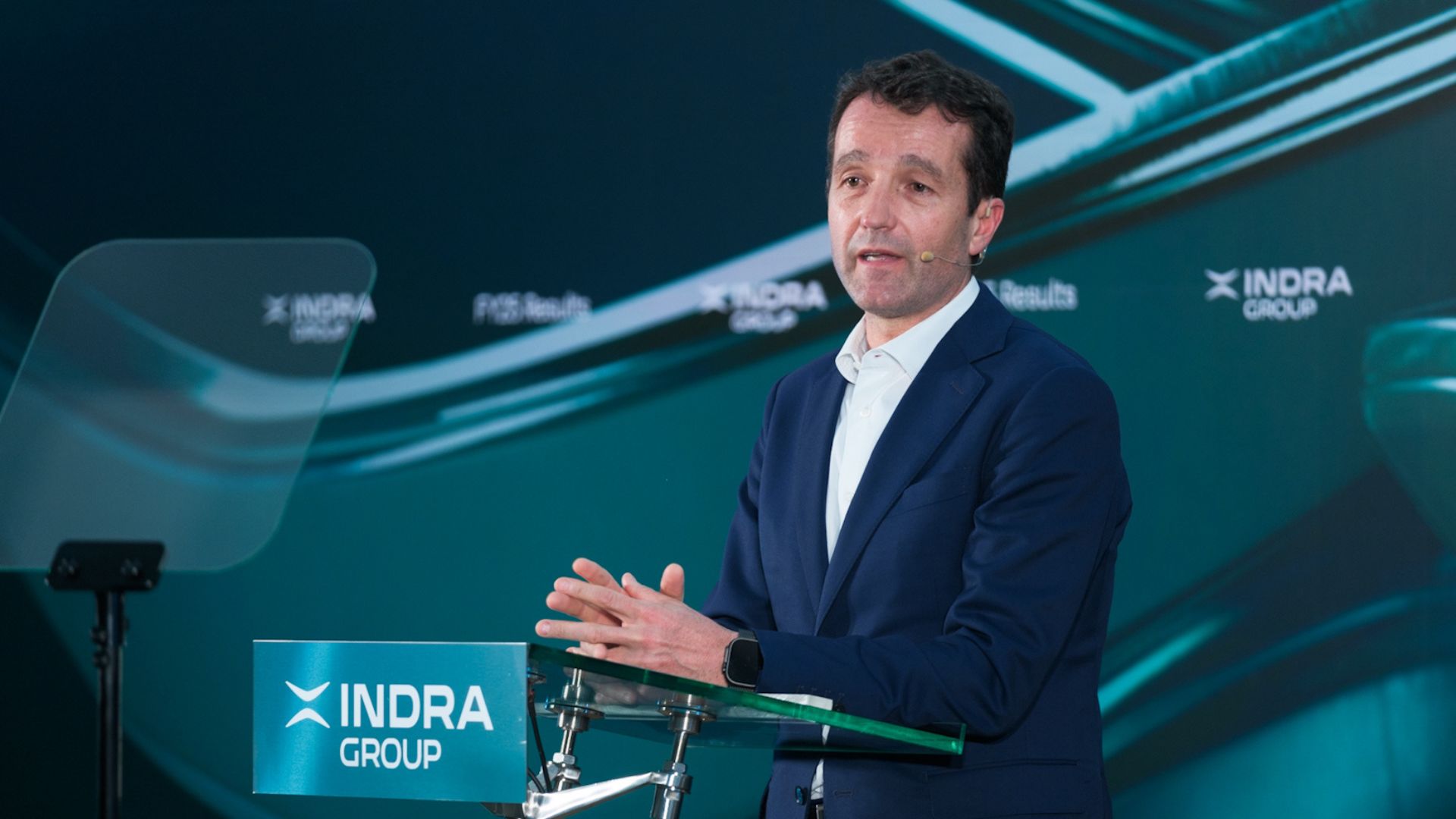
| Ángel Escribano, Indra Group’s executive chairman, emphasized that “this year’s results forcefully confirm the industrial strength that we’re building. Indra Group is currently a company fully prepared to lead the major defence programs that Spain and Europe need, with technological, industrial, and talent-related capabilities that are unique in our country. This year we’ve taken decisive steps to consolidate our own industrial ecosystem with the creation of Indramind, Indra Land Vehicles, Indra Space, and Indra Weapons & Ammunitions, enhancing our standing as a player integral to the defence and security of the 21st century. We’ve been able to anticipate, expand our industrial footprint, and mobilize the national technological ecosystem so as to address a historic moment for our strategic autonomy with guarantees. These results not only prove this, they will drive us to continue accelerating our scale in the domestic and global markets”. As for Indra Group CEO José Vicente de los Mozos, he recalled that “we’ve completed the Leading the Future Strategic Plan a year ahead of schedule, and we’ve done so by easily exceeding all of the goals we set ourselves. Our performance in 2025 reflects a stronger and more profitable company, with an execution capacity that enables us to look towards 2026 with truly exceptional expectations. We’re growing across all of the business lines, expanding our global scale, and reinforcing an industrial project that positions Indra Group at the forefront of Defence, ATM, Mobility and Information Technologies throughout Europe”. |
Main features
The backlog in 2025 totaled €16.083 billion, of which €6.79 billion corresponded to the Special Modernization Programs (SMPs) in the Defence business and €1.429 billion to the consolidation of TESS Defence. If both impacts are excluded, the backlog would have increased by 9% with respect to 2024, driven by the double-digit growths recorded in Air Traffic Management (ATM) (up more than 23%), Minsait (up 9%), Mobility (up 6%), and Defence (up 5%). The ratio between the backlog and sales in the last twelve months stood at 2.95x (vs. 1.50x in the same period of the previous year.
Revenues in 2025 rose by 13%, with all of the divisions displaying considerable growth: Defence 23%, ATM 23%, Mobility 10%, and Minsait 5%. Revenues also rose in all of the divisions in the fourth quarter of 2025: Defence 79%, Mobility 32%, Minsait 10%, and ATM 2%.
- Defence (+36%). The revenues stood at €1.407 billion, with significant rises in Spain, AMEA (Asia, Middle East and Africa) and Europe, driven by Ground Vehicles (with the contribution of TESS and the radars in Vietnam), the Special Modernization Programs and Eurofighter, as well as Space (the Galileo program and the contribution of Deimos) and Weapons and Ammunitions (Meteor).
- ATM (+12%). Air traffic posted strong double-digit growth, especially in the Americas (the radio contract in the United States and Canada iTEC) and Europe (the radar contract in the United Kingdom). It posted €523 million in revenues.
- Mobility (+10%). Revenues amounted to €398 million, with outstanding progress in regions such as AMEA, due to the tolls in the Philippines and the railway in Saudi Arabia, and Europe, with the ticketing projects in Ireland, as well as Spain (ticketing and ITS). Revenues accelerated by 32% in the fourth quarter, with a 69% increase in the Americas as a result of the contracts for Lima Airport (Peru) and the tolls in the United States.
- Minsait (+5%). Minsait recorded €3.129 billion in sales/revenues during 2025, a year with excellent performances in the business lines for the civil sector, including Public Administrations & Healthcare (which rose by 12%), Financial Services (up 4%) and Energy & Industry (up 2%).
The exchange rate subtracted €74 M from the revenues in 2025 (-1.5 percentage points), mainly due to the depreciation of the dollar against the euro and its impact on the currencies in Brazil, Argentina, and Mexico.
Organic revenues in 2025 (excluding the inorganic contribution of acquisitions and the exchange rate effect) rose by 9%, with solid growth in all of the divisions: Defence 17%, ATM 9%, Mobility 8%, and Minsait 6%.
The net order intake in 2025 increased by 139% (10% excluding the SMPs and TESS), with significant growth in all of the businesses, particularly Defence, mainly due to the Air and Space Defence Systems, Ground Vehicles, Ground Systems, FCAS project, Weapons and Ammunitions and Eurofighter project segments. The order intakes also increased in ATM, due to the contribution of the radio renewal contract in the United States, the air navigation radars in the United Kingdom, and the business in Spain, and Mobility, thanks to the railway maintenance contracts in Chile, the urban traffic management in Ireland and the toll project in Colombia. The book-to-bill order intake ratio with respect to sales stood at 2.34x vs. 1.11x in 2024.
The EBITDA Margin in 2025 stood at 11.7% vs. 11.3% in 2024, with 17% EBITDA growth in absolute terms. This improvement in the margins can chiefly be put down to the higher revenue increases in all of the divisions, particularly Defence and ATM. If the impacts of TESS and the exceptional clean-up of an iNM project in Central Europe in ATM are excluded, the EBITDA margin in 2025 would have been 12.2%. In the fourth quarter of 2025, the EBITDA margin stood at 12.5% (14.3% excluding the two impacts) vs. 12.2% in the same period of the previous year. The EBITDA for the fourth quarter rose by 31% in absolute terms.
As for the Operating Margin, it stood at 10.8% in 2025 compared to 10.6% in 2024, with a 15% rise in absolute terms. Other Operating Income and Expenses (the difference between the operating margin and the EBIT) totaled -€73 M vs. -€74 M in 2024, with the following breakdown: -€40 M workforce restructuring costs vs. -€45 M; impact of the PPA (Purchase Price Allocation) on the amortization of the intangibles totaling -€21 M vs. -€16 M, and the provision for the stock-based compensation of the medium-term incentive amounting to -€12 M, the same figure as in 2024.
The EBIT Margin in 2025 stood at 9.5% (10.0% excluding the impact of TESS and the clean-up of the iNM project), compared to the figure of 9.0% recorded in 2024, with the EBIT displaying 18% growth in absolute terms. In the last quarter of the year, the margin stood at 10.8% (12.4% excluding the two impacts), set against the figure of 10.2% in the same period of 2024. The EBIT therefore increased by 35% in absolute terms.
The Net Profit in 2025 stood at €436 M compared to €278 M in 2024, constituting 57% growth, mainly as a result of the operational improvement and the one-off impact on the financial results stemming from the increase in the valuation of the stake in TESS, among other factors.
The Free Cash Flow in 2025 stood at €364 M compared to €328 M in 2024. In the fourth quarter of the year, the cash generation stood at €307 M vs. €234 M in the same period of the previous year.
The Net Debt stood at €583 M in December 2025, set against the positive Net Cash position totaling €86 M in December 2024. The Net Debt/LTM EBITDA ratio (excluding the IFRS 16 impact) stood at 1.0x (affected by the payment of Hispasat+Hisdesat, which did not contribute to the EBITDA) in December 2025, set against the figure of 0.2x recorded in December 2024.
| The 2025 Goals were easily exceeded: Revenues in local currency: €5.53B vs. >5.2 B (6% increase) EBIT: €517 M vs. > €490 M (6% increase) Free Cash Flow excluding TESS and Hispasat+Hisdesat: €319 M vs. >€300 M (6% increase) |
Significant events in the last quarter of 2025
In the last quarter of 2025, Indra significantly enhanced its standing in the space sector and furthered its strategy to consolidate its position as a leading European player. On October 1, Luis Mayo was appointed as director of Indra Space, in keeping with the group’s ambition to become the most integrated company in the space value chain, one which is capable of offering end-to-end missions with a dual civil and military approach.
Likewise, on December 30, the acquisition of 86.68% of Hispasat, an operation previously authorized by the Extraordinary General Meeting held on November 28, was formalized and accompanied by a reorganization of the management structure: Miguel Ángel Panduro became director of Indra Space, and Luis Mayo Muñiz and Ana María Molina took over as the CEOs of Hispasat and Hisdesat.
As for the corporate governance, the quarter was shaped by the decision by Mónica Helena Espinosa Caldas not to become an independent director, which temporarily reduced the number of independent directors and the female representation on the Board. In view of this situation, the company initiated a process to select a new director, led by the Nominating, Compensation and Corporate Governance Committee with the support of a specialized consulting firm. At the same time, the Board approved various adjustments to its internal committees, incorporating María Teresa Busto del Castillo and María Aránzazu Díaz-Lladó Prado into different key bodies.
In the corporate and financial areas, between December 1 and 4 Indra executed a Temporary Repurchase Program for 235,000 shares designed to fulfill the commitments of the executive compensation system, an operation that entailed the temporary suspension of the liquidity contract with Banco Sabadell.
In addition, on December 2, the company reached an agreement for the sale of its BPO unit to Teknei for €96.6 million, further simplifying its perimeter and reinforcing its strategic focus.
Events subsequent to the end of the quarter
Indra Group recorded several significant events after the end of the quarter. On January 2, 2026, Hisdesat Servicios Estratégicos (a company majority-owned by Indra Group) activated a contingency plan to ensure the continuity of the services pledged to the Ministry of Defence and the rest of its customers. The measure was taken after a space particle accidentally collided with the SpainSat NG II satellite during its orbital transfer phase. Despite this incident, Hisdesat confirmed that its operational capabilities remained intact and reaffirmed its commitment to the objectives of the SpainSat NG II program. However, after verifying that the damage prevented the satellite from fulfilling its mission, on January 16, the company, together with the Ministry of Defence, initiated the process to request an offer for the future SpainSat NG III satellite, which would act as a replacement.
On January 15, 2026, Indra Group was awarded the Top Employer certificate for the eighth year in a row, thus consolidating its position as one of the best companies in Spain to work for and strengthening its commitment to excellence in its talent management and professional development.
Subsequently, on January 29, 2026, the Board of Directors, after receiving a favorable report from the CNRGC, agreed to the appointment of Miguel Ángel Panduro as managing director of Indra Space and a new member of the Management Committee.
On February 10, 2026, it was also announced that Indra Group would be included in the MSCI World Index for the first time, in recognition of its performance in the stock market.
Finally, on February 25, 2026, the Board of Directors decided to propose, at the next General Shareholders’ Meeting, the distribution of a cash dividend totaling €0.30 gross per share, to be charged against the results for 2025 and paid on July 9, 2026. On that date, the Payments Business was also reclassified out of Assets Held for Sale.
| Guidance. Goals in 2026 • Revenues in local currency¹: greater than €7 B. • Reported EBIT²: higher than €700 M. • Reported Free Cash Flow³: greater than €375 M. ¹ Includes the consolidation of BPO until its sale ² Does not include the one-off result of the sale of the BPO asset ³ Excludes the advances from Indra’s defence programs (SMPs) and the joint ventures it participates in, and considers constant factoring (€187 M) |
Revenues by geographical regions
Revenues by geographical regions rose in Spain (by 17%; 53% of total sales), AMEA (by 12%; 9% of total sales), Europe (by 9%; 19% of sales) and the Americas (by 5%; 19% of sales).