

IndraMind arrives at the MWC with a sovereign vision capable of shielding industry and scaling AI to anticipate risks and protect the supply chain
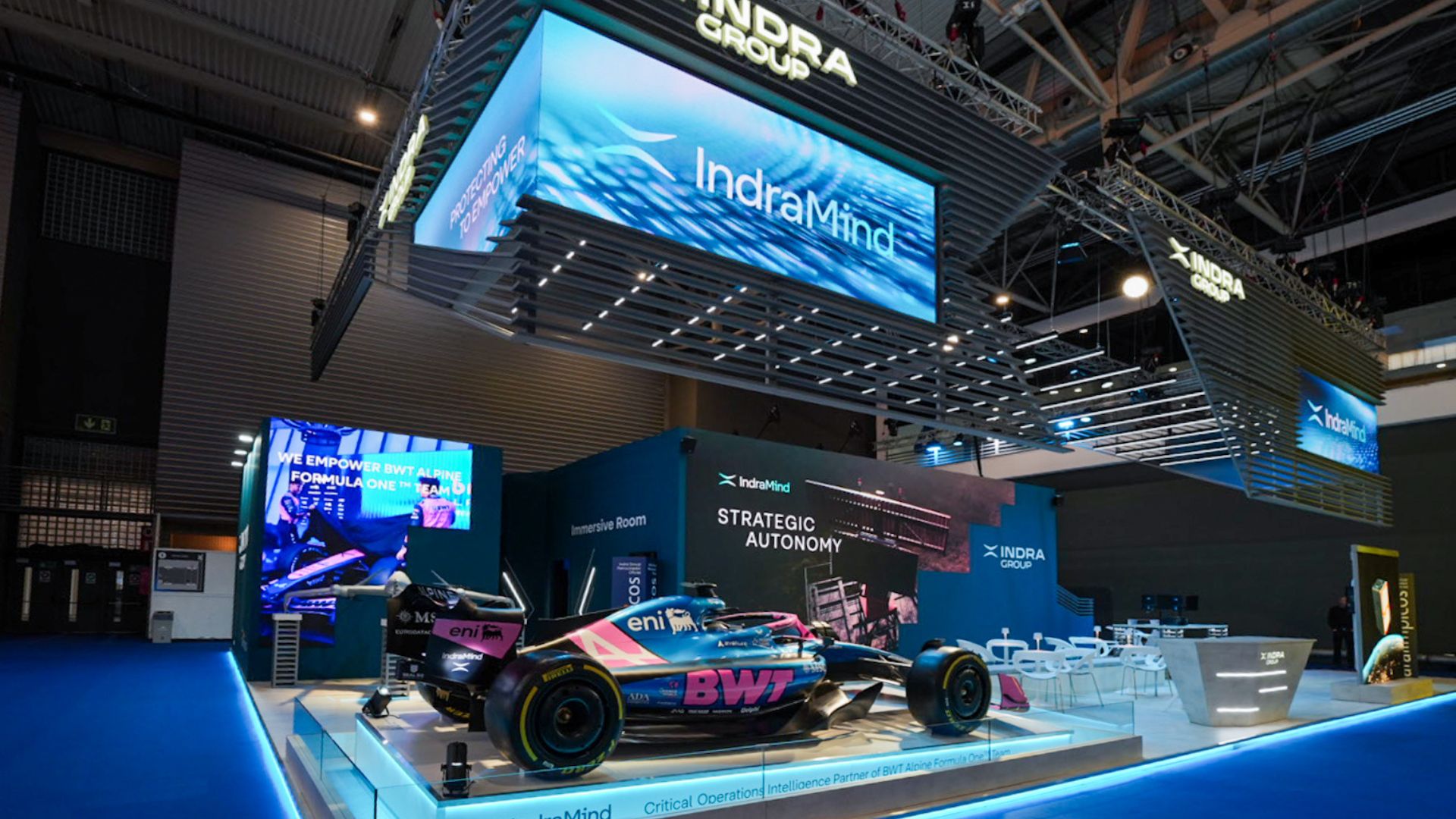
IndraMind CEO Ignacio Martínez attended the congress today to explain how industry needs to move towards a model that can foresee incidents and guarantee the continuous functioning of its operations, managing supply chains as a strategic part of the country while adopting new ways of preventing interruptions affecting production and employment
Industrial organizations currently face a hybrid environment in which cyber attacks, physical disruptions and misinformation are liable to converge, obliging them to move beyond mere efficiency to greater capacity to secure critical supplies, shield processes, and build a true competitive edge in the new era
With IndraMind, Indra Group is incorporating sovereign intelligence into the core of operations so as to anticipate risks, improve understanding of each situation, and act rapidly to protect business continuity and reinforce technological sovereignty
During his speech today at the Mobile World Congress (MWC) in Barcelona, Ignacio Martínez, CEO of IndraMind (Indra Group), emphasized how protecting supply chains has become not only one of the key elements of the industrial transformation but also, and increasingly so, a key component of national security, particularly when it comes to operating in settings shaped by geopolitical tensions and hybrid threats affecting civil infrastructures beyond the military world.
The Indra Group expert, who took part in several production chain-related talks within the context of the MWC, warned of a paradigm shift: in the wake of the pandemic and the crisis affecting raw materials, industry shifted from optimizing operations to increase efficiency to prioritizing resilience, and, now, guaranteeing increasingly secure accesses to more challenging routes and processes beset by greater uncertainty.
“Industry can no longer assume that the geopolitical risk is zero. We’re witnessing a hybrid war in which cyber attacks, physical disruptions and disinformation are likely to converge. And the production chain is one of the most important strategic components, so it’s vital to anticipate scenarios, decide with intelligence, and act before an incident escalates. With IndraMind we put sovereign AI at the heart of the operation to protect the continuity and competitiveness of each link in the chain”, explained Martinez.

Ignacio Martínez, CEO of IndraMind (Indra Group)
This sovereign AI initiative offers a comprehensive and updated vision of everything that happens at the plant and in the supply chain, connecting equipment, processes, and suppliers in a single environment. This means outages can be anticipated, production can be balanced when there are tensions in supplies and the responses of the different areas can be coordinated, enabling the factory to adapt rapidly, minimize shutdowns, and maintain the level of service, even in highly demanding contexts.
A background message provides the key to technological sovereignty: control the data, algorithms, software, and infrastructure to reduce external reliances and guarantee the continuity of strategic services. This constitutes the basis for a sovereign intelligence that’s no longer an option in Europe: “It’s the condition for deciding within our own perimeter and protecting what matters in the civilian, security, and defence spheres”, he remarked.
How IndraMind operates in industry and scales AI
Industries that rely on complex supply chains need to have a plan in place before a crisis occurs. The head of IndraMind has divided this plan into four clear measures: control stocks, have preferential suppliers capable of expanding their production if an incident occurs, diversify industrial partners so as not to depend on a single country or company, and, when the risk is too high, create national capacity to manufacture essential components.
Managing this model requires a solution that serves as a nervous system for the supply chain. On the first strategic tier, it analyzes risks, draws heat maps indicating where problems may occur, and simulates scenarios so as to decide which levers to activate. On a second more operational tier, it constantly monitors the warning signals (from traditional logistical data to information from open and restricted sources) and proposes automatic and semi-automatic responses when it detects significant changes.
IndraMind provides the architecture that’s necessary for this ecosystem to really work properly by incorporating artificial intelligence ranging from data capture to scenario simulation, thus ensuring sovereign control over the technology and reinforcing cyber resilience. The foregoing is crucial in an environment in which threats are no longer just digital, but also physical and electromagnetic. Moreover, by executing the intelligence in the field, relying on supercomputing, and connecting with autonomous systems, the platform can reduce reaction times and maintain operational continuity, even in critical situations.
This approach, stressed IndraMind’s CEO, “enables countries and companies to anticipate problems, activate plans before a crisis breaks out and ensure that strategic supplies keep flowing. Our goal is for the factory to be as intelligent as the environment it faces. We have a way of managing industry that endows it with the capacity to do just that, to compete and to continue growing in a world in which resilience and sovereignty are as important as efficiency”.
Martínez attended several areas of the Manufacturing & Production Summit today to address the challenges facing industries and supply chains as a result of the growing degree of global instability, and he did so through IndraMind, which has already redefined its operations in critical environments. His speech was part of Indra Group’s presence at the Mobile World Congress in Barcelona. The company is attending the MWC with a comprehensive proposal which, besides including critical technologies, covers the revolution in space and showcases Minsait’s solutions for defence, mobility (T-mobilitat and London), and connectivity.