

One in every three consumers still can’t pay the way they'd like to: Nuek observes that there are still invisible barriers to digitalizing payments
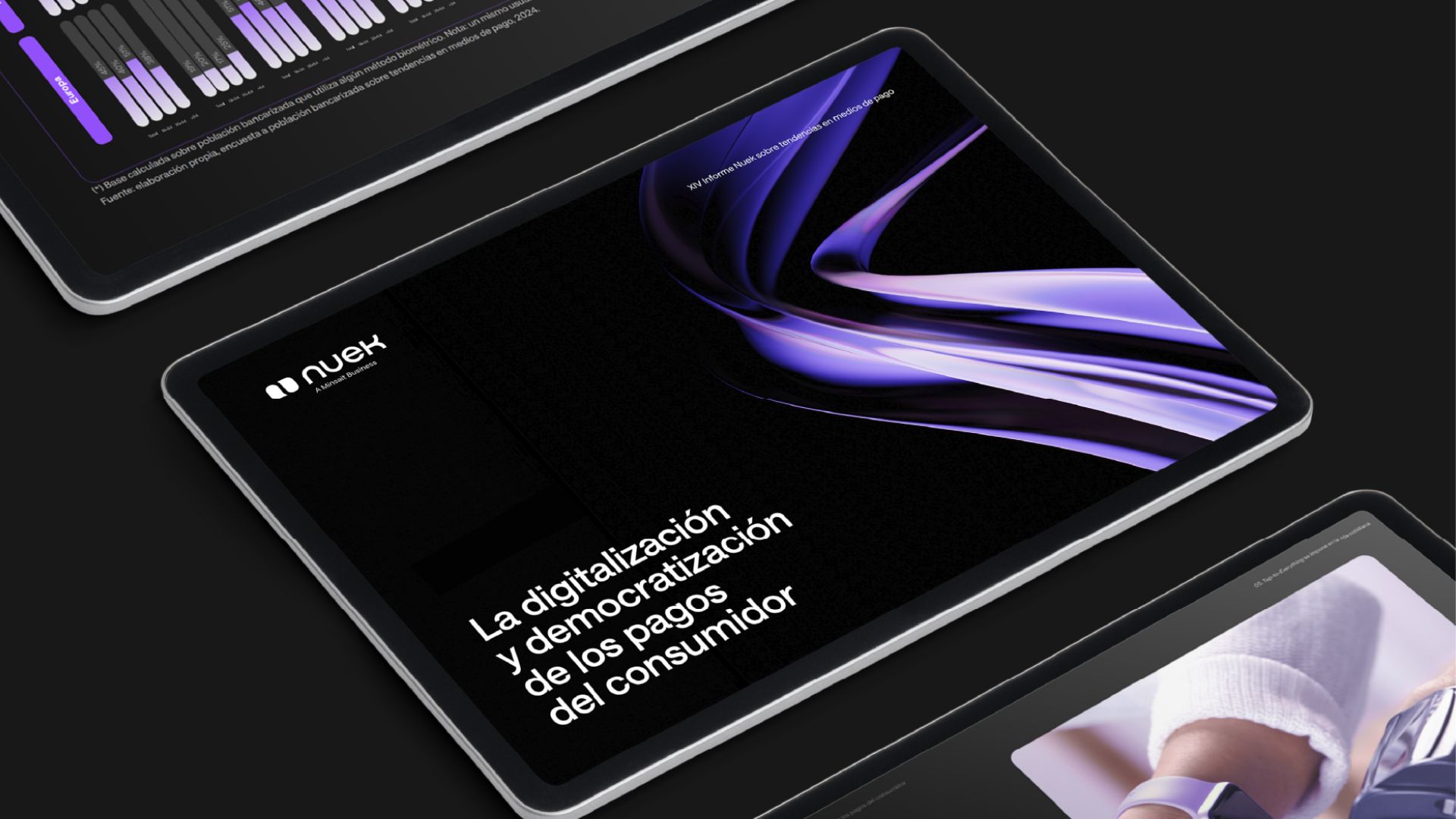
In its latest study, the company shows how, while digital payments are on the rise, there are still structural barriers preventing a truly universal, secure and interoperable experience for millions of people
Cash is still being used, not because people prefer it, but because there is a lack of viable alternatives; it is still the most widely used in-store payment method in Colombia and Ecuador
Biometrics and tokenization are shaking up security: 63% of mobile users already use biometrics for authentication purposes. Tokenization reduces fraud in e-commerce by up to 60%
Although the digitalization of payments is progressing steadily in Europe and Latin America, millions of people are still unable to choose how to pay. This was revealed in a new report by Nuek, a technology company specializing in payment infrastructure belonging to Minsait (Indra Group), which identifies the main divides that continue to hinder a truly universal, secure and frictionless financial experience.
The study, titled “The digitalization and democratization of consumer payments”, presented today by the company, has been drawn up in partnership with AFI (Analistas Financieros Internacionales) and based on over 5,200 surveys conducted in Argentina, Brazil, Chile, Colombia, Ecuador, Mexico, Peru, Dominican Republic, Uruguay, Spain, Italy, Portugal and the United Kingdom. Its main findings include the fact that 66% of consumers with a bank account in the above countries have had to use a payment method other than the one they would have preferred in the past year, due to a lack of acceptance, technological shortcomings or operational restrictions.
“When 66% of users can’t pay as they’d like to, the problem isn’t a technological one. It’s design-related. At Nuek, we believe that true innovation in payments doesn’t lie in offering more options, but in providing an experience that simply works, without the need to think, adapt or slow down”, stated the firm’s CEO, Javier Rey.
The report confirms that cash, although use is waning, is still the most widely used payment method when there are no real alternatives, as is the case in Colombia and Ecuador, where over 60% of in-store payments are still paid in cash.
Debit cards are consolidating their position as the mainpayment method in markets such as Spain, Portugal, Chile and Uruguay, while they are competing with credit cards in Mexico and Brazil. Account-based payments have also seen a sharp rise, thanks to solutions such as Pix (Brazil), MBWay (Portugal) and Bizum (Spain). In Argentina, Colombia and Peru, instant transfers are becoming more widespread.
Meanwhile, contactless payments are becoming the norm. Over 60% of users with smart devices make them regularly. But the phenomenon goes beyond the above: 70% of users in countries such as Colombia, Mexico and Peru would like to extend this model to other actions, such as confirming a transaction, sending money or linking a new card with a single touch.
This new way of dealing with money isn’t just faster. It’s more intuitive and accessible and more aligned with most people's mobile and digital habits. What was until recently a technological innovation has become a basic consumer expectation.
Security, biometrics and identity: a new standard
One of the major changes identified in the report is the consolidation of biometrics as the authentication standard. 63% of users with smart devices currently use their fingerprint or face to authorize their payments. In Latin America, this preference is associated with a feeling of greater security. In Europe, the speed and convenience of the operation is more important.
This change is occurring at the same time technologies such as tokenization are becoming more advanced, which replaces the card’s actual data with a unique code (the token) that’s transmitted during the transaction. According to the report, one out of every three e-commerce transactions in Spain is now tokenized, leading to a reduction in fraud by up to 60% and a 5% increase in the authorization rate. Security has ceased to be an obstacle and has now become a facilitator of experience.
The report also reveals that people are more than willing to adopt a single digital identity. 70% of Latin American and 60% of European users would be willing to use a single credential for paying, identifying themselves, performing financial transactions and gaining access to services. This paradigm shift foresees a convergence between the worlds of identity, authentication and transactions.
Five challenges that the industry has yet to resolve
Despite the progress that has been made, the report lists five structural shortcomings that the industry still needs to resolve if it wishes to deliver on the promise of a truly universal, secure and frictionless payment experience.
Firstly, access remains unequal; having a digital payment method doesn’t guarantee that this can actually be used in all contexts.
Secondly, security is still perceived as needing improvement; although technologies such as biometrics and tokenization can improve the experience, many users still have to put up with slow or unintuitive processes when they pay.
Thirdly, there’s a lack of integration; payment systems don’t always work in the same way across countries, banks and platforms, meaning users have to adapt.
Fourthly, paying is increasingly becoming a form of identification that calls for clear rules and reliable technology.
Lastly, the experience isn’t invisible yet; the goal is no longer merely contactless payments, the goal is to have an obstacle- and interruption-free experience that requires very little effort.
(Access to the Report: https://www.nuek.com/publicaciones/industria/pagos-digitales-para-todos-asi-avanza-la-democratizacion-del-consumo-financiero/)