Indra Group’s backlog exceeds €20 billion, with double-digit growth in revenues, EBIT and net profit
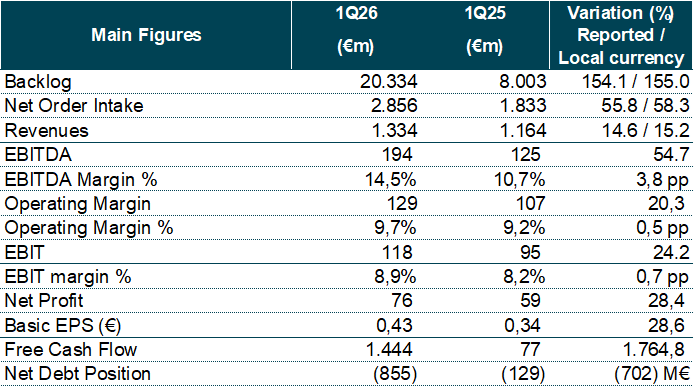
The backlog amounted to €20.334 billion in the first quarter of 2026 set against the figure of €8.003 billion in the same period of 2025, with significant growth in all of the divisions
The order intake in the first three months of the year stood at €2.856 billion, constituting a 56% year-on-year increase, with growth in all of the divisions
Revenues grew by 15% in the period compared to the first quarter of 2025, with year-on-year increases in all of the units, particularly the double-digit rises in Defence and ATM
The EBITDA and the EBIT recorded respective 55% and 24% year-on-year increases, thus improving Indra Group’s profitability by 0.7 percentage points, with the EBIT margin reaching 8.9% in the first quarter of the year
The net result amounted to €76 million, a figure 28% higher than in the first quarter of 2025, while the free cash flow (FCF) stood at €1.444 billion in this period of 2026, compared to €77 million in the first three months of the previous year
The company has reiterated all of its financial targets for 2026: more than €7 billion in revenues in local currency, an EBIT greater than €700 million and a free cash flow amounting to over €375 million
Revenues increased by 15%, totaling €1.334 billion in the first quarter of the year
The company confirms its roadmap and maintains its financial targets for 2026
| Indra Group CEO José Vicente de los Mozos emphasized that “the first quarter results reaffirm our commitment to the year’s guidance. We’re fully focused on developing our industrial footprint, promoting strategic agreements, and leveraging our technological capabilities so as to fulfill our commitments to our customers. Once again, we’re continuing to deliver on the Leading the Future Strategic Plan and we’re working on defining the new Scale Up phase”. |
Acquisitions contributed €109 million to sales in 1Q26 vs €1 million in 1Q25. The acquisitions of TESS Defence and AERTEC contributed inorganically to Defence, Hispasat and Hisdesat contributed to Space, and Micronav and Global ATS contributed to ATM.
Quarterly highlights
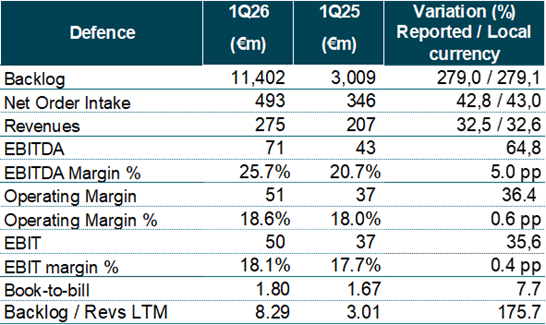
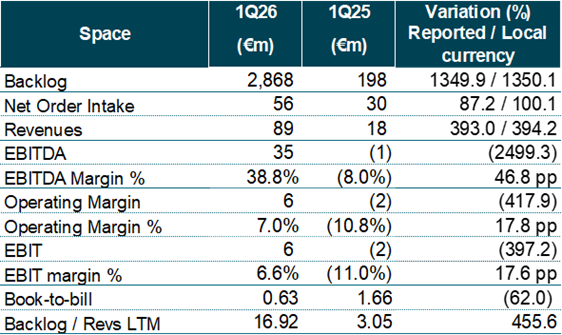
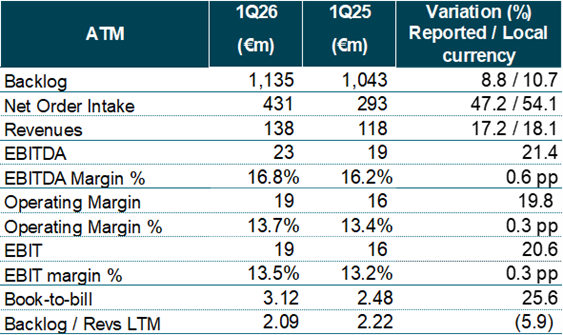
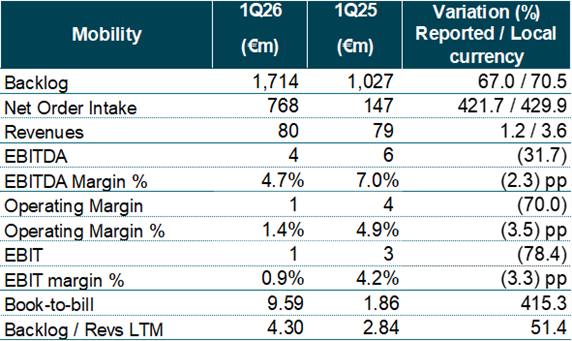
The backlog in the first quarter of 2026 amounted to €20.334 billion, a 154% increase compared to the same months of 2025, driven mainly by Defence (more than €8.394 billion) and the inorganic contribution of Space (the consolidation of Hispasat and Hisdesat totaling €2.704 billion), with all of the other divisions also contributing to the growth. The ratio between the backlog and sales in the last twelve months stood at 3.61x, set against the figure of 1.64x in the same period of the previous year.
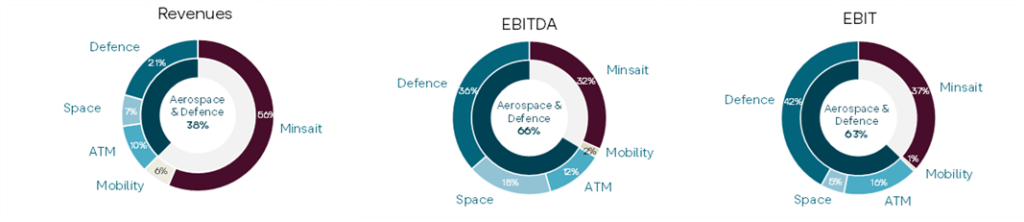
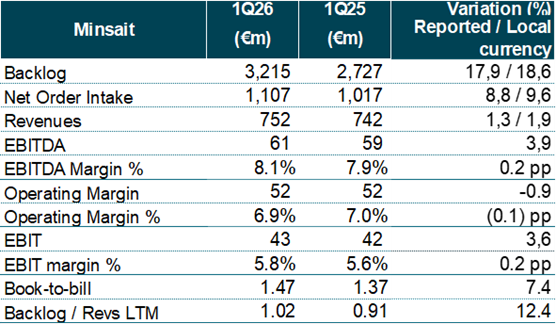
Revenues during the quarter rose by 15%, with all of the divisions displaying growth: Space increased by 393%, Defence rose by 33% and ATM grew by 17%, while Mobility and Minsait each went up by 1% respectively.
- Space (+393%). Revenues soared, mainly due to the inorganic contribution resulting from the integration of Hispasat and Hisdesat, with significant influence displayed by the businesses in Spain and the Americas (the services managed in Mexico, Brazil and Peru). The progress was also significant in Europe, due to the inorganic contribution of Germany (Axess) and the evolution of the Galileo program.
- Defence (+33%). Revenues grew sharply, with significant increases in both Spain and AMEA, with support mainly coming from the increased activity of the Special Modernization Programs, Land Systems, and the Land Vehicles area (driven by the contribution linked to TESS), in addition to the progress of the Naval Systems. The Eurofighter program continued to evolve positively, while the FCAS recorded a decline compared to the previous year.
- ATM (+17%). Revenues advanced with double-digit increases, particularly in the Americas (due to contracts such as the radios in Brazil and Canada) and AMEA (radars in the United Arab Emirates and the renewal of air traffic management systems in Vietnam), with positive evolutions in other geographical regions.
- Mobility (+1%). Revenues remained virtually stable; growth was driven by the strong performance of the Americas (especially the toll systems in the United States) and Spain (the ticketing and Intelligent Transport Systems), while it was partially offset by the falls in Europe (the ticketing in Ireland) and AMEA (the railway network in Saudi Arabia).
- Minsait (+1%). Revenues grew slightly, with an improved performance of the Public Administrations and Healthcare and stability in Financial Services, while the rise was conditioned by the declines in Energy and Industry and, in particular, Telecom and Media.
The exchange rate subtracted €7 million from revenues in the first quarter (-0.6 pp), mainly due to the depreciation of the dollar against the euro and its impact on the currencies in the United States, Argentina, and Peru.
Organic revenues in this period (excluding the inorganic contribution of acquisitions and the effect of the exchange rate) rose by 6%, with significant increases in Defence (more than 19%) and ATM (15%), as well as Mobility, with a 4% increase, and Minsait (2%). In turn, organic revenues fell by -24% in Space during the quarter.
Net order intake in the first quarter of 2026 increased by 56%, with significant growth in all of the businesses, particularly Mobility (which rose by 422%), mainly driven by the management contract for London’s transport network in the United Kingdom (€605 M of the Transport for London project) and the railway system contract in Saudi Arabia (€107 M of the Mecca-Medina high-speed train project). The order intake in Space increased by 87% thanks to the Americas, Hispasat’s services business in Peru, and Hisdesat. ATM recorded a 47% increase due to the Americas (the surveillance radar contract with the FAA in the United States) and AMEA (the radar manufacturing contract for the airport in the United Arab Emirates), with Spain displaying double-digit growth. Defence grew by 43%, mainly due to the significant contribution of the Simulation business (the Special Modernization Program for an integrated advanced flight training system as a subcontractor of Airbus), the Special Modernization Programs, and the international FCAS project. Finally, Minsait recorded a 9% increase, thanks to the 58% growth recorded by the Public Administrations and Healthcare, and that of Financial Services (which rose by 5%). The procurement book-to-bill sales ratio stood at 2.14x, set against the figure of 1.57x in the first quarter of 2025.
The EBITDA margin stood at 14.5% in the first three months of the year, compared to the figure of 10.7% in the same period of the previous year, with the EBITDA increasing by 55% in absolute terms. These improved margins can mainly be put down to the greater growth in revenues recorded in the divisions with the largest margins (Defence and ATM), as well as the inorganic contribution of Hispasat and Hisdesat.
The operating margin in this period stood at 9.7% compared to 9.2% in the same period of the previous year, with 20% growth in absolute terms. Other operating income and expenses (the difference between the Operating Margin and the EBIT) amounted to -€11 million versus -€12 million in the first quarter of 2025, with the following breakdown: -€4 million workforce restructuring costs in both periods, a -€3 million PPA (Purchase Price Allocation) impact on the amortization of intangibles versus -€5 million, and the -€3 million provision for stock-based compensation of the medium-term incentive, the same figure as in the first quarter of 2025.The EBIT margin stood at 8.9% in the first three months of 2026, compared to the figure of 8.2% in the same period of 2025, with the EBIT displaying a 24% increase in absolute terms
The net result in the first quarter of 2026 stood at €76 million compared to €59 million in the same months of 2025, constituting a 28% increase, mainly as a result of the operational improvement.
The free cash flow in this period of the year stood at €1.444 billion versus €77 million in the first quarter of 2025, mainly driven by the advances received for the Special Modernization Programs. If we exclude the net impact of the working capital of these programs and consider a constant historical factoring totaling €187 million (as recorded at the closure of all of the quarters in previous years), the company’s FCF would have stood at -€40 million in the first quarter of 2026.
With respect to the net debt, the Group ended March 2026 with a positive Net Cash position amounting to €855 million, compared to the figure of €129 million in March 2025. The Net Debt/LTM EBITDA ratio (excluding the IFRS 16 impact) stood at -1.3x compared to -0.2x at that time.
| Goals for 2026 • Revenues in local currency1: greater than €7 billion. • Reported EBIT²: greater than €700 million. • Reported Free Cash Flow3: greater than €375 million. ¹ Includes the consolidation of BPO until its sale ² Does not include the one-off result of the sale of the BPO asset ³ Excludes the advances from Indra’s Defence programs (SMPs) and the joint ventures it participates in, and considers constant factoring (€187 M) |
Other events during the quarter
On January 2, Indra Group announced that Hisdesat Servicios Estratégicos, S.A. (“Hisdesat”) had activated a contingency plan to ensure the continuity of the services pledged to the Ministry of Defence and its other customers following the accidental collision of a space particle with the SpainSat NG II satellite during the orbital transfer phase. Hisdesat confirmed that its operational capabilities had not been affected and, after determining that the damage would prevent the completion of the mission, on January 16, 2026, together with the Ministry of Defence, it initiated the process of requesting an offer for the SpainSat NG III satellite to replace the SpainSat NG II.
On January 15, the company obtained its Top Employer certificate for the eighth year in a row.
On January 29, the Board of Directors, after receiving a favorable report from the CNRGC, agreed to the appointment of Miguel Ángel Panduro as managing director of Indra Space and a member of the Management Committee.
On February 10, it was announced that Indra Group would be included in the MSCI World Index for the first time, in recognition of its performance in the stock market.
On February 25, the Board agreed to propose to the next Annual General Shareholders’ Meeting the distribution of a cash dividend totaling €0.30 gross per share, charged against the profits in 2025 and to be paid on July 9, 2026, and, on the same date, it approved the formal closure of the process of analyzing divestment alternatives for Minsait Payments (currently Nuek).
Between March 3 and 9, Indra executed a Temporary Share Buyback Program to meet its obligations to deliver shares to executives resulting from the current remuneration system by acquiring 235,000 shares (0.13% of the capital), which involved suspension of the liquidity contract throughout the term of the program.
On March 18, SEPI published a statement at the CNMV regarding a letter sent to Indra Group conveying its concern about the influence of a conflict of interest in the analysis of a potential operation with Escribano Mechanical & Engineering, and, on March 19, the Board, at an extraordinary meeting, acknowledged the letter in which EME announced its withdrawal, thus concluding the process of analyzing said potential operation.
On March 24, Indra Group and Hanwha Group signed a binding agreement for the development of self-propelled artillery systems, including a €130 million investment in new industrial capabilities, and, on March 26, Rheinmetall and Indra Group signed a memorandum of understanding to reinforce their strategic partnership for the production of military vehicle systems for European and Latin American Armed Forces.
Events subsequent to the end of the quarter
On April 1, following the closure of the quarter, Indra Group’s Board of Directors acknowledged the resignation formally submitted on that day by Mr. Ángel Escribano Ruiz as a director, as executive chairman of the Company, and as chairman of the Executive Delegate Committee and Strategy Committee. As a result of the above, the coordinating independent director, Ms. Virginia Arce Peralta, in coordination with the Nominating, Compensation and Corporate Governance Committee, initiated the succession process for the position of chairman of the Board of Directors.
On April 2, the Board approved several agreements: it appointed Mr. Ángel Simón Grimaldos by co-option as a director in an “another external” status, and designated him as non-executive chairman of the Board of Directors, with Mr. José Vicente de los Mozos remaining as Indra Group’s CEO and chief executive.
In the industrial field, on April 17, Indra Land Vehicles and IDV (a company in the Leonardo group) reached a strategic agreement for the new Marine Infantry Amphibious Combat Vehicle (VACIM), as requested by the Spanish Ministry of Defence within the framework of a Special Modernization Program (SMP).
Results by business units
Revenues by geographical regions
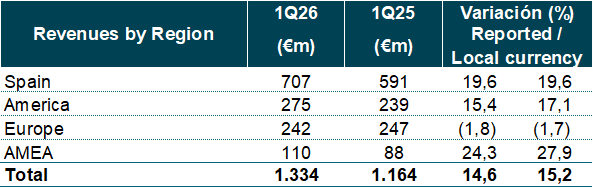
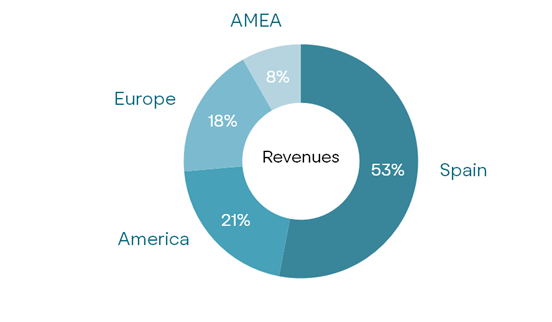
Revenues by geographical regions recorded increases in AMEA (by 24%; 8% of total sales), Spain (by 20%; 53% of total sales), and the Americas (by 15%; 21% of total sales), in contrast to the falls recorded in Europe (by 2%, equivalent to 18% of total sales).