

Indra Space leads two strategic ESA projects to contribute to future governmental services for the low-leo layer of IRIS²
ATLAS leverages the technological and operational expertise acquired by Startical to take air traffic management (ATM) communications and surveillance from space to a new level.
SELENE will work on the feasibility of a 5G-NTN space infrastructure to provide direct communications to government and defense user terminals, one of the areas with the greatest growth potential for the space sector.
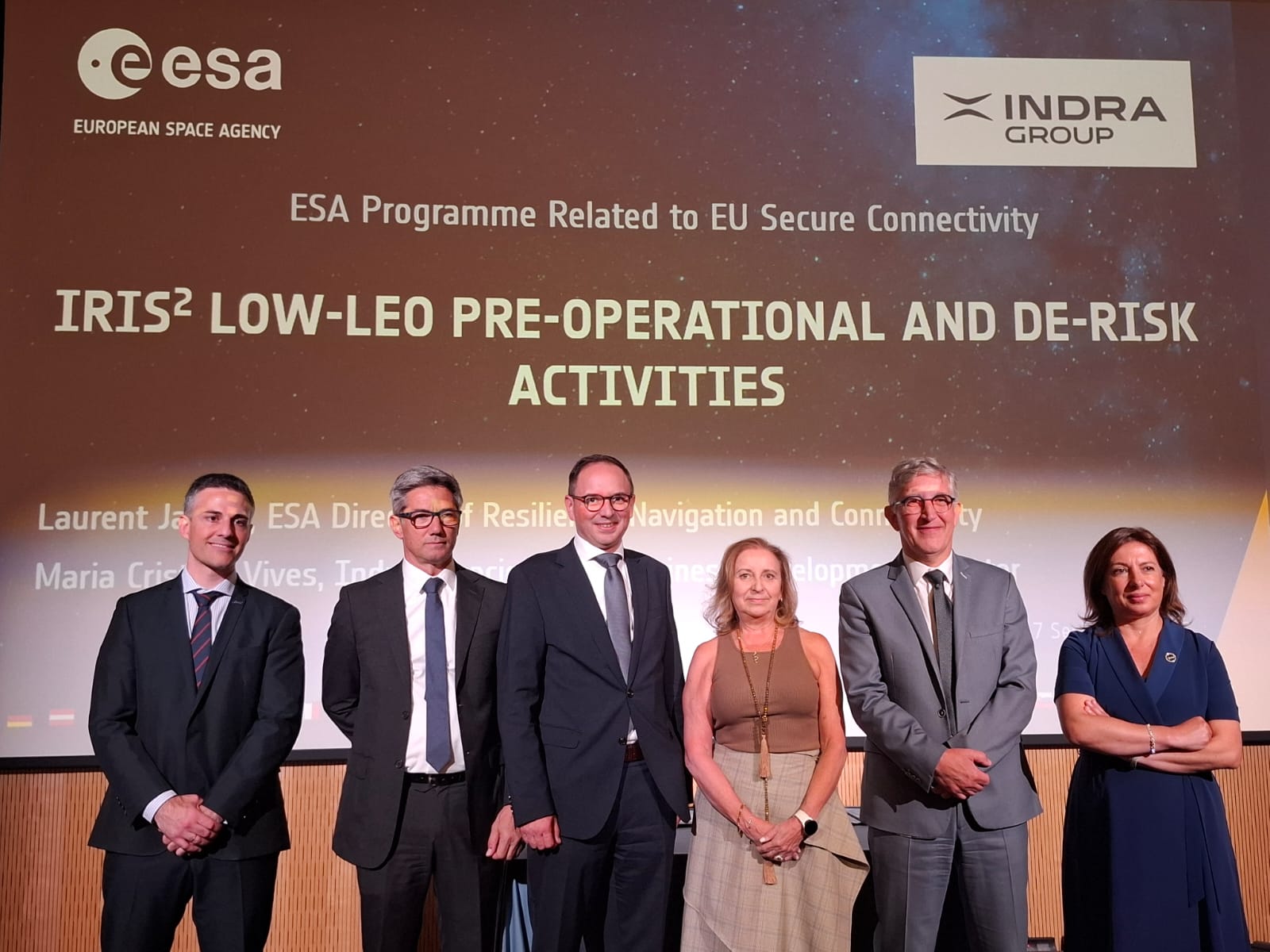
The European Space Agency (ESA) has selected two projects led by Indra Space, ATLAS and SELENE, to move into the Consolidation phase of IRIS² Low LEO Pre-Operational and De-Risk Activities. As a result, these two highly innovative projects will be overseen by ESA with the aim of reducing their technological risks, and to consolidate mission concepts with potential for incorporation into future versions of the Low-LEO layer of IRIS², the European Union’s secure satellite communications system.
This initial competitive consolidation phase will last approximately four months. Following this stage, ESA will initiate a subsequent procurement with a limited number of mission demonstrators to enter the implementation phase, covering the full cycle of development, deployment, and in-orbit validation. Demonstration missions are expected to be launched towards the end of the decade.
Innovative Air Traffic Management and future-oriented Direct-to-Device Communications Projects
The two projects led by Indra Space are complementary initiatives designed to accelerate the development of future European space capabilities for resilient government services.
ATLAS focuses on validating a space-based air traffic management (ATM) communications and surveillance system, leveraging the technological and operational expertise gained by Startical, a company set up by ENAIRE, the Spanish air navigation service provider, in collaboration with Indra to provide space-based communication and surveillance services designed to improve air traffic management. Its objective is to carry out an IRIS²-compatible in-orbit validation that will help bring global air navigation services to a new level. The project also involves Aerospacelab, Sener Aeroespacial, Stellar Project, DHV Tecnología Espacial Avanzada Malagueña, EOSOL Engineering Consulting, CITD Engineering Technologies, and Startical. This consortium will provide ATLAS with key capabilities in satellite platform development, payloads, communications, power systems, structures, and the operational definition of space-based ATM services.
SELENE, meanwhile, aims to demonstrate the viability of a comprehensive space infrastructure based on 5G Non-Terrestrial Networks (5G NTN) technology to provide government services and next generation direct-to-device communications for government and defense users, one of the areas with the highest growth potential in the space sector. The SELENE consortium comprises Celeste, Druid Software, Aerospacelab, Thales Alenia Space España, Sener Aeroespacial, Stellar Project, Hisdesat, and i2CAT. These companies and organizations bring expertise in 5G technologies, satellite platforms, advanced antennas, optical inter-satellite links, and system operations.
IRIS², Europe’s Secure Satellite Communications Programme
IRIS² is Europe’s secure satellite communications programme for commercial and governmental applications in areas of high strategic value. It is a public-private partnership involving the European Commission -in collaboration with the European Space Agency (ESA)- and a consortium formed by Europe’s three leading satellite operators: HispaSat, Eutelsat, and SES. Total investment in this multi-orbit system exceeds €15.6 billion and, according to the agreed schedule, its first launches are expected to take place in 2029.
The programme includes the development of the system’s Very Low Earth Orbit layer (Low LEO), which will operate below an altitude of 750 km. This layer will host the programme’s most innovative missions. It will also provide access to the ecosystem of European startups and SMEs already developing cutting-edge space solutions.
ESA’s selection of these two projects further strengthens Indra Group’s position in the development of European space capabilities, contributing to Europe’s technological autonomy, security, and sovereignty in a strategic domain expected to experience significant growth over the coming decades.
About ESA Programme Related to EU Secure Connectivity
Under the overall responsibility of the European Commission, IRIS² is a bold endeavour to build a space-based secure and resilient connectivity network that elevates Europe’s strategic autonomy and competitiveness, where and when it matters most. ESA acts on behalf of the European Commission as the qualification and validation authority for the governmental infrastructure of the Union Secure Connectivity Programme. It manages development and validation contracts supporting the initial space and ground segments, verifies end-to-end system, service, and security performance against EC requirements, and coordinates these activities with ESA’s own programme.
Within this programme, the IRIS² Low-LEO Pre-Operational and De-Risk Activities components provide a rapid and recurrent mechanism for validating potential new governmental services and associated mission concepts in orbit up to a pre-operational level, subject to successful maturation and later programme level decisions of integration into the operational EU IRIS² baseline.
Ultimately, these activities aim at contributing to the continued evolution and enhancement of IRIS2 services and capabilities, supporting Europe’s long-term leadership in space in an ever-changing world.
Learn more at: https://resilience.esa.int/esa-programme-related-to-eu-secure-connectivity-and-iris%C2%B2