


Our goal: net zero emissions by 2040
Our strategy
Commitment to climate change

In 2020 we committed to limiting global warming to 1.5°C, in line with Science-Based Targets (SBTi), in partnership with the United Nations Global Compact and the We Mean Business coalition.
We have set a target to reduce our emissions in line with the Paris Agreement and the 2030 Agenda. This ambition includes not only the emissions resulting from our own activity, but also those from our value chain. To this end, we have established interim targets for 2023, 2026, and 2030. In this way, we are moving towards the energy transition and a progressively decarbonised future.
Long-term climate change scenarios
Indra Group has conducted an assessment of material risks, both physical and transition-related, associated with climate change. This analysis used qualitative and quantitative climate scenario modelling, based on the following: the RCP 2.6 “very stringent” and RCP 8.5 “business as usual” scenarios developed by the Intergovernmental Panel on Climate Change (IPCC); and the 2DS and STEPS (Stated Policies Scenario) scenarios of the International Energy Agency (IEA).
The scope of the assessment includes Indra Group’s own operations, as well as a specific contextual analysis of the physical impacts of climate change. It also considers potential scenarios of legislation, technological development, or market conditions that could affect the company’s operations. The analysis is consistent with the company’s long-term strategy.
As a result of the assessment, Indra Group has defined action plans for each of the most relevant risks. These action plans address the specific physical risks of each activity. The timelines of these action plans are adapted to each risk and include actions for the next 5, 10, or 30 years. The 2024–2026 ESG Plan also addresses climate change risks from a global perspective, including actions that extend beyond its timeframe.
Energy efficiency solutions
It is important to highlight that, through Minsait, Indra Group has an Energy business unit that helps promote sustainability, control, and energy efficiency in utility companies. More information on services and solutions for the energy industry is available here.

Our roadmap for decarbonisation
We design and implement an ambitious climate strategy, with concrete measures to reduce emissions and move towards environmentally responsible management.
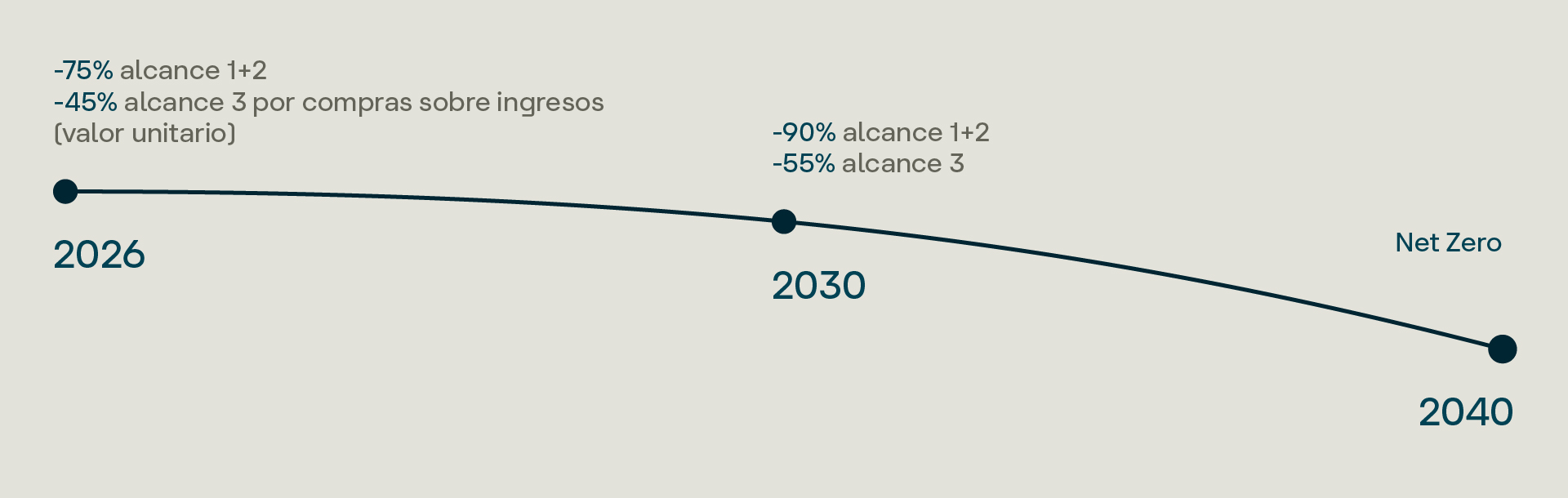
Our Environmental Policy includes an expanded carbon emissions calculation that covers all scope 3 emissions from the value chain, including those from purchasing, business travel, and employee commuting.
Our Net Zero target, validated by SBTi
0,05
emissions intensity per employee (scope 1+2 tCO₂e)
88,4%
renewable energy in Spain
91%
energy from renewable sources
Our strategy towards decarbonisation
Efficient climate control
Sustainable mobility
Our commitmentEnergy efficiency (ISO 50001) and renewable energy
Sustainable procurement
Supply chainData
Measurable emissions reduction: our progress in figures
We monitor our emissions rigorously to make data-driven decisions and ensure a real and sustained reduction over time.
| Carbon footprint data (tCO₂e) | 2019 | 2022 | 2023 | 2024 | 2025 |
|---|---|---|---|---|---|
| Scope 1: direct CO₂ emissions from gas, diesel, and refrigerant gases | 2.733 | 1.681 | 2.035 | 1.831 | 1.534 |
| Scope 2: indirect CO₂ emissions from electricity consumed (market based) | 6.198 | 1.211 | 1.182 | 829 | 1.394 |
| Scope 3: indirect CO₂ emissions from the value chain | 492.422 | 377.224 | 424.304 | 446.461 | 573.067 |
| Intensity (scope 1+2) | 0,188 | 0,053 | 0,057 | 0,044 | 0,047 |
Breakdown of scope 3 emissions in 2025 (tCO₂e), according to the GHG Protocol:
Category 1: Goods and services – 276.783 | Category 2: Capital goods – 15.718 | Category 3: Fuel- and energy-related activities – 298 | Categories 4 and 9: Transport and distribution – 12.066 | Category 5: Waste generated – 276 | Category 6: Business travel – 18.618 | Category 7: Employee commuting – 45.616 | Category 8: Leased assets – 8.915 | Category 11: Use of sold products – 89.987 | Category 12: End-of-life treatment – 302 | Category 15: Investments – 104.488
N.A. categories: 10, 13, and 14.
Documents