Indra Group accelerates its order intake in the third quarter, again recording double-digit growth in revenues and EBIT
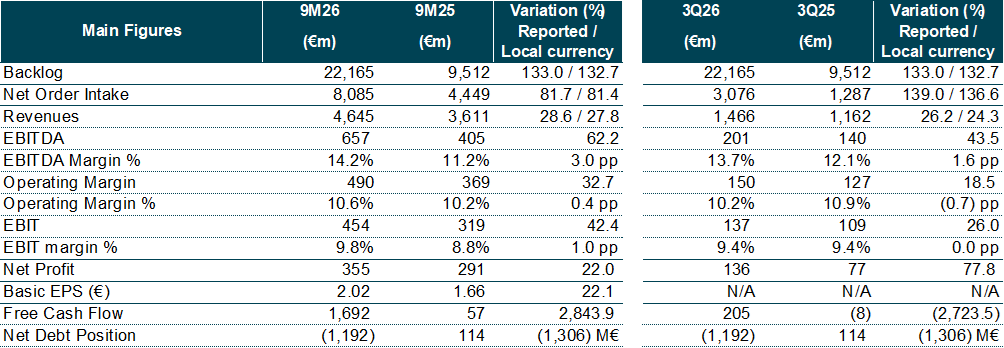
The backlog reached €22,165m in the first nine months of 2026, set against €9,512m recorded in the same period of the previous year, with all of the divisions contributing to the growth.
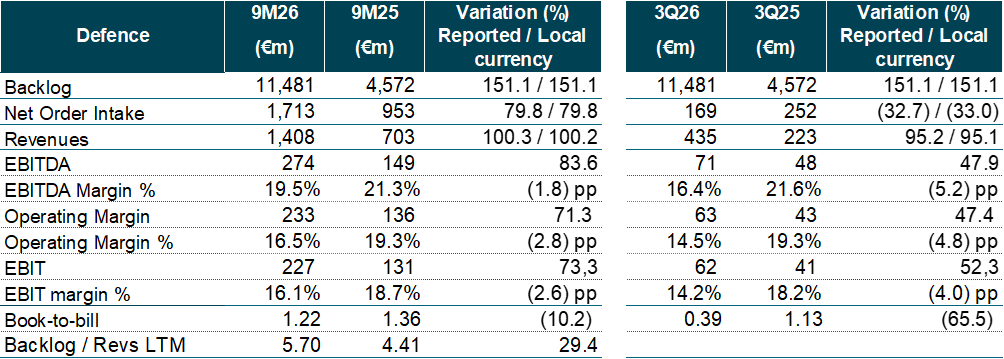
Order intake continued its year-on-year growth trend and stands at €8,085m, accelerating its performance in the third quarter of the year (139%), mainly driven by IRIS² contracts in Space.
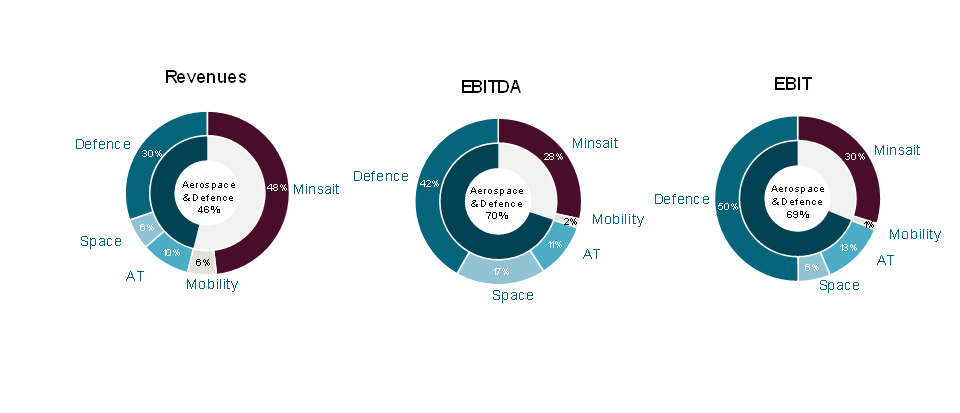
Revenues increased by 29% compared with the first nine months of 2025, with year-on-year increases in all of the divisions, including Defence (100%) and Air Traffic-AT- (23%).
The EBITDA and EBIT recorded respective 62% and 42% year-on-year increases, improving Indra Group’s profitability by 1.0 percentage point (a 9.8% EBIT margin in the period compared with 8.8% in the same period of the previous year).
Net profit amounted to €355m, up 22% year-on-year.
Free Cash Flow (FCF) totaled €1,692m in the first nine months of 2026, compared with €57m in the same period in 2025.
In the third quarter of the year, the acquisition of a 30% stake in TRC (IndraMind) and 100% of Dares Technology (Defence) was announced, along with the acquisition of the industrial plant in As Pontes (Galicia).
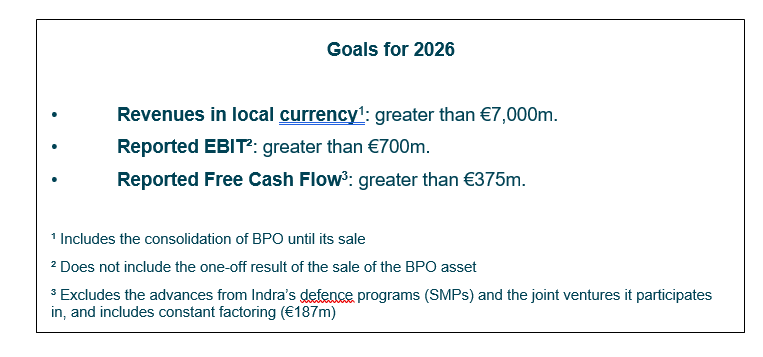
The company reaffirms all of its financial targets in 2026: over €7,000m in revenues in local currency, an EBIT over €700m, and a free cash flow amounting to over €375m.
Revenues increased by 29%, totaling €4,645m in the first nine months of the year
The company reaffirms its 2026 financial targets for another quarter
Acquisitions provided a total of €529m in sales in the first nine months of 2026 vs. €11m in the same period of 2025. The acquisition of TESS Defence contributed inorganically to Defence, Hispasat and Hisdesat contributed to Space, and Micronav and Global ATS contributed to AT. As for divestments, Minsait’s BPO division contributed €62m to sales in the first three quarters of the year, compared with €143m in the same period of the previous year.
Most important results
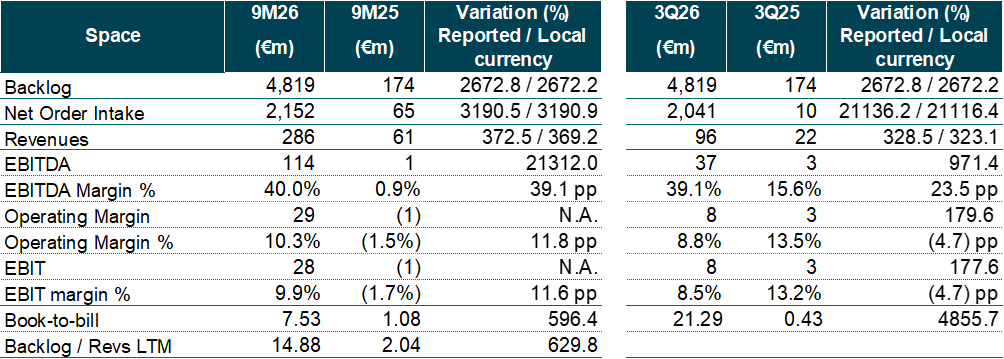
The backlog from January to September 2026 totaled €22,165m, a 133% increase compared with the same period in 2025, driven mainly by Defence (€6,909m) and Space (€4,645m), thanks to the consolidation of the Hispasat and Hisdesat backlog totaling €2,722m and contracts worth €1,926m under the IRIS² program; as well as by Mobility and the Transport for London contract (€605m). Both Air Traffic (AT) and Minsait also contributed to growth during the period. The ratio between the backlog and sales in the last twelve months stood at 3.42x, set against the figure of 1.88x in the same period of the previous year.
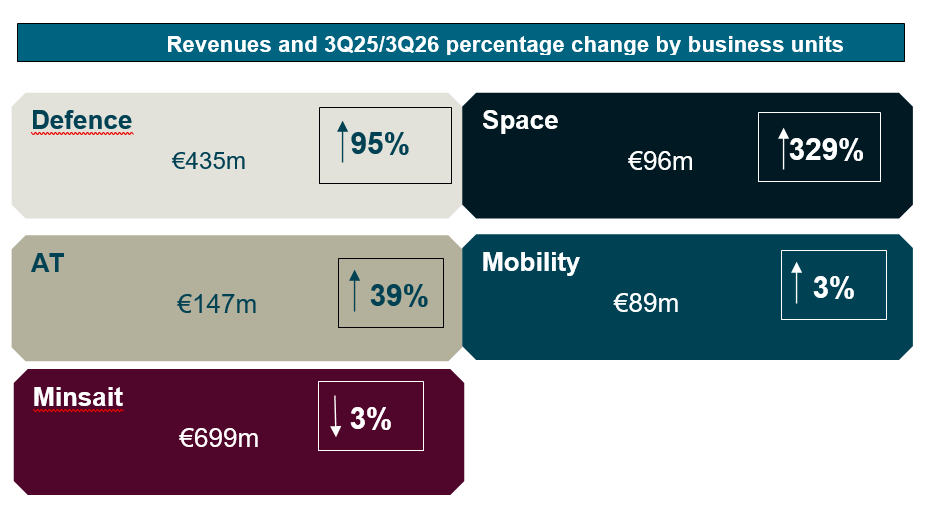
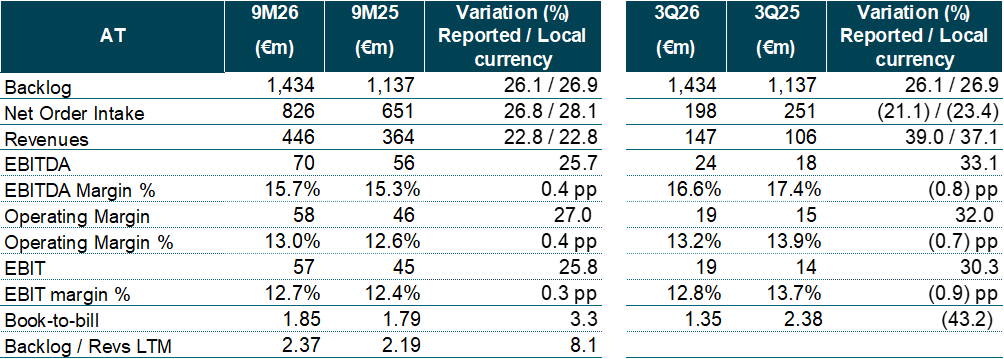
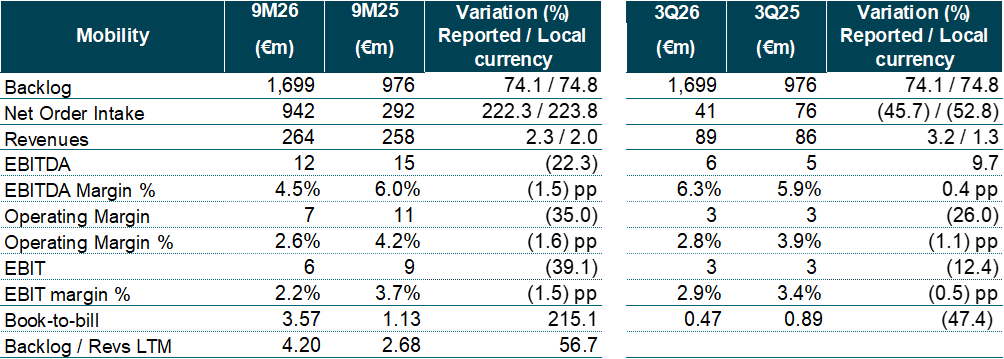
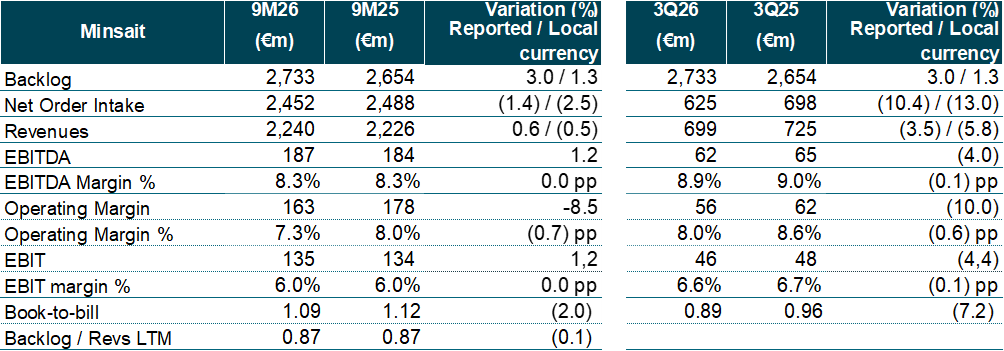
Revenues through September 2026 rose by 29% year on year, with all of the divisions showing growth during the year-to-date period: Space grew by 372%, Defence by 100%, AT by 23%, Mobility by 2%, and Minsait by 1%. Meanwhile, third-quarter revenues grew by 26%, highlights being increases of 329% in Space, 95% in Defence, 39% in AT, and 3% in Mobility, while Minsait recorded a 3% decline.
- Defence (+95%). Sales rose sharply, driven by the contribution of the Special Modernization Programs, the Land Vehicles business and the radar projects in Germany and Ukraine, as well as the strong performance of the Weapons & Ammunition segment. In contrast, the FCAS program made a smaller contribution than the one recorded in the same period of the previous year.
- Space (+329%). Sales increased significantly, driven by the inorganic contribution of Hispasat and Hisdesat, with notable performance from the businesses in Spain, the Americas and Europe.
- AT (+39%). Revenues advanced, supported by strong growth in activity in the Americas, driven by radar and radio contracts in the United States, as well as in AMEA and Europe, fueled by radar and air traffic management system projects in several international markets.
- Mobility (+3%). Sales recorded moderate growth, highlighting the positive performance of the businesses in Spain, especially in ticketing solutions and Intelligent Transport Systems.
- Minsait (-3%). Revenues were primarily affected by the deconsolidation of the BPO business, in a context marked by declines in Telecom & Media, Financial Services, Energy & Industry, and Public Administrations & Healthcare.
The exchange rate contributed €28m to revenues during the first nine months of 2026 (+0.8 pp), chiefly due to the appreciation of the currencies of Colombia, Brazil, and Mexico against the euro.
Organic revenues in the same period (excluding the inorganic contribution of acquisitions and divestments and the effect of the exchange rate) rose by 16%, with significant increases in Defence (61%) and AT (22%), as well as 3% in Minsait and 2% in Mobility. In turn, the organic revenues of Space fell by 17% over the nine months of 2026.
The net order intake in the first nine months of 2026 increased by 82%, with significant growth in all of the businesses, particularly Space, which rose by more than 3.191%, mainly driven by the IRIS² program, whose award to Hispasat as the prime contractor for the program’s ground segment and Low LEO constellation generated order intake of €1,926m during the quarter; as well as Mobility (more than 222%), primarily due to the Transport for London contract, the railway system contract in Saudi Arabia, and the Transport for Washington contract. Meanwhile, the order intake in Defence increased by 80%, driven by the significant contribution of the Eurofighter project (€489m), the Special Modernization Programs (€206m), the Simulation business (105m related to the PEM for an advanced integrated flight training system as an Airbus subcontractor), and the Air Defence division (a €129m radar contract in the Democratic Republic of the Congo).
Meanwhile, order intake in AT rose by 27%, highlighted by the radar contract in the Democratic Republic of the Congo and the United Arab Emirates, radio contracts in Egypt, and the surveillance radar contract with the FAA in the United States. Lastly, hiring at Minsait fell by 1%, mainly due to declines in Telecom & Media and Energy & Industry.
Net hiring in the third quarter of 2026 grew by 139%, driven by the Space segment, thanks to the contracts already mentioned under the IRIS² program framework.
As a result, the book-to-bill order intake ratio with respect to sales stood at 1.74x versus 1.23x in the first nine months of the previous fiscal year.
The EBITDA margin stood at 14.2% over the same period, compared with 11.2% for the same nine-month period in 2025, with a 62% increase in EBITDA in absolute terms. These improved margins can mainly be attributed to the greater growth in revenues recorded in the divisions with the largest margins (Defence and AT), as well as the inorganic contribution of Hispasat and Hisdesat. If we exclude the impact of TESS, the EBITDA margin would have stood at 15.0%. Regarding only the third quarter of the year, the EBITDA margin stood at 13.7% (14.5% excluding the above impact) vs. 12.1% in those three months of 2025, with 44% EBITDA growth in absolute terms.
As for the Operating Margin, in the first nine months of 2026, it stood at 10.6% versus 10.2% over the same period in 2025, with a 33% rise in absolute terms. Other operating income and expenses (the difference between Operating Margin and EBIT) amounted to -€37m versus -€51m last year, with the following breakdown: -€22m for workforce restructuring costs vs. -€29m; the impact of the PPA (Purchase Price Allocation) on the amortization of the intangibles totaling -€13m versus -€12m; a provision for the stock-based compensation of the medium-term incentive amounting to -€9m, the same figure as in the same nine-month period of 2025; and, finally, the effect of the sale of the BPO business, which generated a €7m profit.
The EBIT margin from January through September stood at 9.8% (10.4% excluding the impact of TESS), compared with 8.8% in the same months of 2025, with EBIT displaying a 42% increase in absolute terms. With respect to the third quarter of the year alone, the margin stood at 9.4% (9.9% excluding the above impact), equal to the same quarter in 2025 (also 9.4%), with the EBIT increasing by 26% in absolute terms.
Regarding the Net Result, in the first nine months of 2026 it stood at €355m compared with €291m in the same period of 2025, constituting a 22% increase, mainly as a result of the operational improvement. Excluding the one-off impact resulting from the increase in the valuation of the stake in TESS recognised in the previous year, net profit would have increased by 64%.
The free cash flow, also from January to September, stood at €1,692m vs. €57m the previous year, mainly driven by the advance payments received for the Special Modernization Programs. If we exclude the net impact of the working capital of these programs and consider a constant historical factoring totaling €187m (as recorded by Indra Group at the closure of all of the quarters in previous years), the company’s FCF would have stood at €70m in the first nine months of the current fiscal year.
As for Net Debt, the group ended September 2026 with a positive Net Cash position totaling €1,192m (€431m Net Debt excluding PEM advances and considering factoring at a level equivalent to previous periods), compared to Net Debt of €583m in December 2025 and €114m in September 2025. The Net Debt/LTM EBITDA ratio (excluding the IFRS 16 impact) stood at -1.4x in September 2026 (0.5x excluding PEM advances and considering factoring at a level equivalent to previous periods), compared with 1.0x in December 2025 and 0.2x in September 2025.
Other significant events during the quarter
The third quarter of 2026 was marked by significant advances in the space sector and a reorganization of the company’s management structure. In August, the SpaceRISE consortium, made up of Eutelsat, SES, and Hispasat, in which Indra Group holds a majority stake, concluded negotiations with the European Commission and the European Space Agency for the development of IRIS², the future European secure satellite communications system, which will enter service in 2030. In this context, Hispasat will play a significant role as the prime contractor for the ground infrastructure and in developing the system’s very-low-Earth-orbit layer, strengthening Indra Group’s position in one of the most strategically important programs for European technological sovereignty and defence.
Additionally, on September 29, the Board of Directors approved a comprehensive restructuring of the organizational structure and the Executive Committee to align the company with its new strategic priorities, streamline the organization, strengthen execution capabilities, and accelerate decision-making. Among the main measures adopted are the appointment of Juan Ramón Hernández as General Manager of Defense and Space and Frank Torres as General Manager of Operations, the integration of international activities into the various business units, and the merger of the AT and Mobility divisions, as well as Finance and Management Control. Additionally, the creation of a new General Management of Strategy, Technology and Product was approved, along with various amendments to the Regulations of the Board of Directors and its Committees to reinforce certain aspects of corporate governance.
In addition, at the end of the quarter, Indra Group reached an agreement to acquire a 30% stake in the cybersecurity company TRC, a transaction that will help strengthen the Spanish technology ecosystem in this area and complement the capabilities of IndraMind’s offering.
Results by business units
Revenues by geographical regions

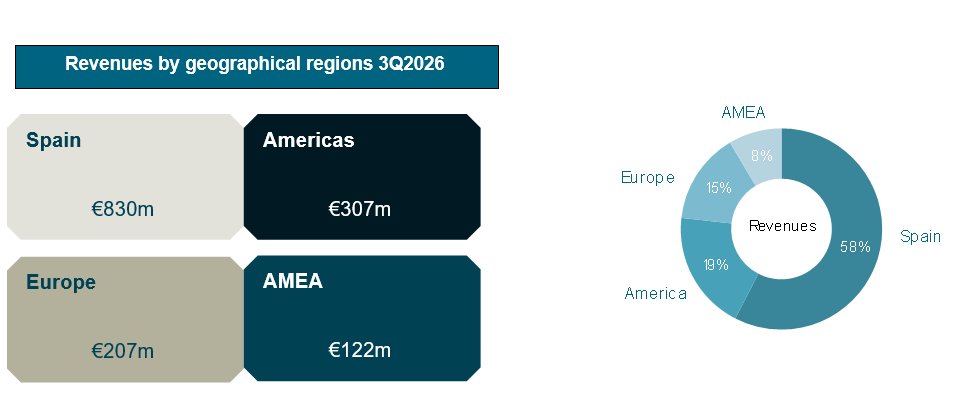
Revenues by geographical regions recorded double-digit increases in Spain (by 48%; 58% of total sales), Asia, the Middle East and Africa (AMEA) – which grew by 25%; 8% of total sales – and the Americas (by 21%; 19% of total sales), in contrast to the falls recorded in Europe (by 10%; accounting for 15% of total sales).